Suffering With a Sports Injury in Leeds
Sports Injury in Leeds
If you're an active adult in Leeds, your feet and ankles do a lot of quiet, unglamorous work. So when something starts to hurt, it isn't a minor inconvenience. It can bring your whole routine to a halt.
A sports injury in Leeds can be genuinely frustrating, especially in your twenties and thirties, when you feel fit and expect your body to bounce back quickly. You get caught between two instincts: push through and hope it settles, or stop and worry you're undoing all your hard-won progress.
At Ankle & Co, we understand that you don't simply want to be told to rest. You want to recover properly and get back to the sport you love without the nagging fear of it happening again. If you're currently sidelined, here's a clear look at what might be going on, why active young adults are prone to certain foot and ankle problems, and when it's worth seeing a specialist.
Training hard takes its toll: common foot and ankle injuries
Being active in your twenties and thirties is one of the best things you can do for your long-term health. It also places real, repeated demands on your lower limbs. The impact of running, jumping and the stress of sharp directional changes can quietly turn ordinary tissue fatigue into something that stops you in your tracks. If you're trying to work out why your training has hit a wall, the cause is usually one of a handful of familiar culprits.
Arch pain from running
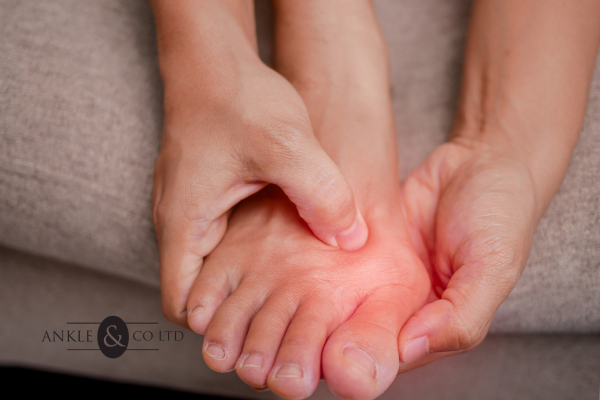
For the local running community, from weekend park runners to anyone building up for the Leeds Half Marathon, the arch of the foot is a frequent trouble spot. Arch pain from running around Leeds usually points to strain in the plantar fascia or the posterior tibial tendon.
When you run, your arch works as a natural shock absorber. It flattens to take the impact, then springs back to push you forward. Increase your mileage too quickly, pound hard city pavements without enough support, or carry an underlying biomechanical imbalance, and those structures become overloaded. The result is a dull, burning or sharp ache along the sole of your foot that turns every stride into a chore.
Heel pain in young adults
There's a stubborn myth that chronic heel problems only trouble older people. In reality, heel pain in young adults is remarkably common across Leeds, particularly among those who favour high-impact training, CrossFit, or stop-start sports such as football and padel.
The usual offender is plantar fasciitis, which tends to announce itself as a sharp, stabbing pain under the heel during your first few steps in the morning. Another common one is Achilles tendinopathy, felt as stiffness and tenderness at the back of the heel and often worse after a spell of rest. Ignore these early signals and the tissue can gradually degenerate, turning a passing irritation into a long-running problem.
Acute and traumatic injuries
Overuse injuries creep up on you. Traumatic ones arrive in a heartbeat. A bad twist on a football pitch in Headingley, or an awkward landing in a five-a-side game, can leave you with the kind of sports foot injury active people across Leeds dread. These range from acute ankle sprains, where ligaments are stretched or torn, to stress fractures: tiny cracks in the bones of the foot caused by repetitive load without enough recovery.
This is also where specialist input matters most. Persistent pain after an ankle injury, a joint that keeps giving way, or a fracture that isn't healing as it should are all good reasons to have things looked at properly rather than left to chance.
Why "walking it off" rarely works
When you're young and generally fit, the pull to ignore the pain and carry on is strong. Maybe you take ibuprofen before a run, or strap up a swollen ankle and hope it sorts itself out.
The trouble is that masking the symptoms does nothing for the underlying cause. Training through a biomechanical injury usually leads to compensation, where your body subtly changes how you move to protect the sore area. That shifts load onto your knees, hips or lower back, and a small foot problem starts to ripple upwards into something far more tangled.
There's a simple principle worth holding onto: the earlier an injury is correctly diagnosed, the simpler and quicker the recovery tends to be. Getting the right opinion early often prevents a minor strain from becoming chronic damage that keeps you out for months. If something has been grumbling for more than a couple of weeks, that's your cue to book a consultation and have it assessed.
A sensible way to manage your recovery
If you're dealing with an injury right now, your first job is to protect the tissue while you plan a structured return. Recovery is rarely a straight line, but a logical framework helps.
The first 48 to 72 hours
For the first couple of days after an acute injury or a bad flare-up, focus on settling things down and protecting the area:
- Ease off the impact. Switch out high-impact training. If running hurts, swim or use a stationary bike to keep your fitness ticking over without loading the foot.
- Ice sensibly. Apply an ice pack wrapped in a towel for around 15 minutes at a time to help manage swelling.
- Elevate. When you rest, prop the leg up on a cushion to help fluid drain away from the injury.
Beyond the first few days
Real recovery is about more than waiting for the pain to fade. It means understanding why the injury happened and rebuilding your body to handle the load again. That's where a proper clinical assessment earns its place, and where guessing tends to fall short.
When to see a foot and ankle specialist
When you're looking for help, it's worth finding someone who understands the demands of sport rather than someone who simply tells you to stop running. That advice is rarely what an active person wants, or needs, to hear.
Ankle & Co is the practice of Mr Ray Monkhouse, one of the most senior foot and ankle surgeons in Leeds and West Yorkshire. Persistent pain after an ankle injury, pain that comes on with regular exercise, joint instability, mid-foot pain, and pain in the ball of the foot. In other words, exactly the problems that sideline active people. Seeing a foot and ankle specialist in Leeds with this depth of sports experience means your diagnosis and plan are matched to your sport, your goals and your particular anatomy.
A specialist consultation generally involves three things:
- A thorough assessment. A detailed history and a hands-on examination to understand how the injury happened and what's driving the pain.
- An accurate diagnosis. Imaging such as X-rays or scans where they're needed, so the problem is identified properly rather than guessed at.
- A clear treatment plan. This runs from conservative measures, activity and footwear guidance, and onward referral where appropriate, through to surgical options such as ankle ligament repair or reconstruction, Achilles tendon surgery, or keyhole (arthroscopic) procedures when an injury genuinely calls for them.
The aim isn't only to get you out of pain. It's to leave you stronger, steadier and more confident when you step back onto the track, the pitch or the gym floor. You can see the full range of treatments on our service page
Your partner in sports recovery in Leeds
At Ankle & Co, there's no one-size-fits-all approach. We know how much your training means to you, and the goal is to guide your recovery with clarity, honesty and genuine clinical expertise.
Whether you're battling stubborn heel pain, struggling with arch discomfort on your runs, or recovering from a sudden sprain or fracture, you'll be assessed by a consultant who has treated patients of every age and ability. Appointments are available privately at Nuffield Health Leeds, as well as through NHS clinics in the city, so there's a route that fits your situation.
You can read more about Mr Monkhouse's background and experience here
Don't let pain decide your routine
Living with a sports injury can make your world feel frustratingly small. The good news is that you don't have to work it out alone. Taking action now, while a problem is still minor, can save you months of compromised training and repeated setbacks.
Let's get to the root of your pain and build a realistic, structured plan to get you back to your best.
Take the first step towards a confident recovery. Talk through your symptoms with a specialist or arrange a consultation today.